

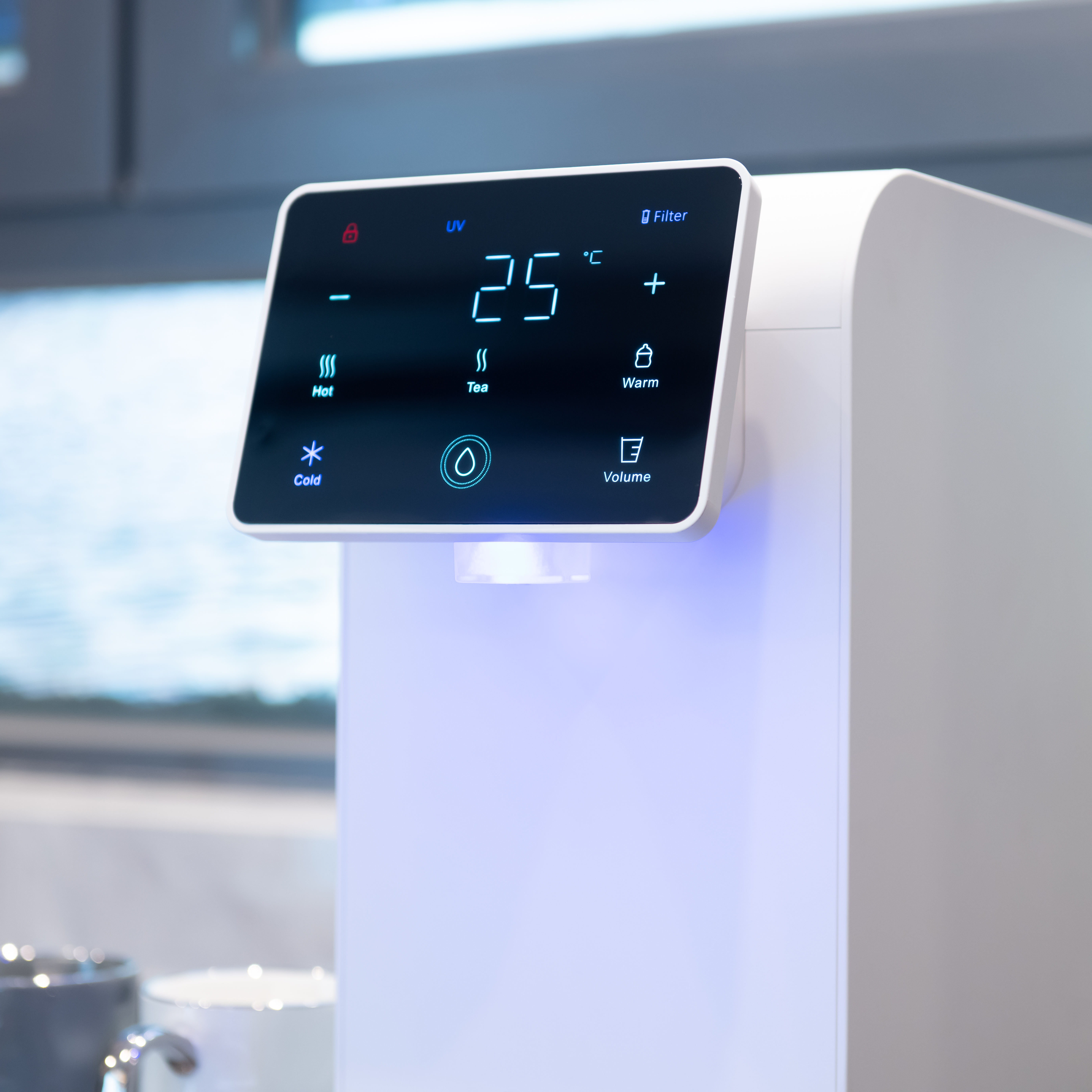
If you’ve browsed water purifiers recently, you’ve probably noticed something odd: two machines with identical “RO reverse osmosis, 400G flow rate” labels, one priced at $125 and the other at $550. The salesperson talks endlessly about “imported membranes,” “smart screens,” and “mineral water,” but you’re left with one question: What exactly am I getting for the extra $425?
That question is precisely what the entire industry is being forced to answer. In 2026, the water purifier industry stands at a turning point. The old playbook—low prices, high volume, marketing gimmicks—is losing its power. And for ordinary consumers, understanding this shift can help you avoid the biggest trap of all.
A Sobering Number, and a More Important Truth
Start with a surprising data point. In the first four months of 2026, domestic water purifier retail volume dropped 24% year-over-year. The reason is straightforward: subsidy policy adjustments removed water purifiers from the national trade-in program. Short-term demand had been pulled forward and exhausted.
But if you conclude from this number alone that “water purifiers are finished,” you’ll miss the real signal. Data disclosed at the same industry conference shows that household penetration of water purifiers in China is currently only about 30%, far lower than in developed countries . In other words, seven out of ten households still don’t have one. It’s not that they don’t need it—they just haven’t been convinced yet.-3
Meanwhile, another trend is quietly unfolding. According to the 2026 Water Purification Industry Trend White Paper jointly released by JD.com and Ipsos, China’s household water purifier penetration rate jumped from 20% in 2023 to around 30% in 2025, with water purifiers transitioning from an “optional appliance” to a “necessity” . More interestingly, premium models have become the “first stop” for new users—67% of premium countertop water purifier buyers are first-time purchasers, and the same figure reaches 63% for under-sink purifiers .-
知乎
-12
The new generation of consumers isn’t planning to buy a cheap one and test the waters. They want to get it right the first time.
What Are Consumers Actually Paying For?
This brings us back to the core question: what’s the difference between the $550 machine and the $125 one?
The answer is shifting from “filtration precision” to “experience precision.” In the past, everyone compared “who could filter water cleaner.” Now, clean water is the baseline. 2025 online data shows that mineral water purifier sales share surged from 7.0% in 2024 to 20.7% in 2025, and products with ice-making functions grew online sales from $43 million to $109 million . Consumers are no longer satisfied with “pure water”—they want “good water”: water with minerals, water that makes ice, water that adapts to different drinking scenarios.-1-4
Angel’s “Golden Ratio” mineral water dispenser is a typical example. Its logic isn’t simply “filter, then add some minerals back.” It uses AI algorithms and proprietary sensor technology to precisely control the calcium-to-magnesium ratio within a 5:1 healthy range, displaying water quality data in real time on the screen. Health has moved from “conceptually healthy” to “visible data” .-5
Philips takes a different path: ice-and-heat integration. One machine covers water dispensers, tea bar machines, water purifiers, and under-sink systems across multiple scenarios—kitchen for cooking, living room for guests, study for work. Drinking water is transforming from a “function” into a “lifestyle.”
The Industry Is Also Hitting the Brakes on “Involution”
Interestingly, as consumers upgrade, the industry itself is actively applying the brakes.
The China Household Electrical Appliances Association explicitly listed “governing involution” as a key priority at its 2026 work conference, opposing vicious price competition and false advertising . The 15th Five-Year Development Outline for the Water Purifier Industry released by the China Membrane Industry Association goes further, setting the tone directly: pushing the industry from “price-oriented” to “value-oriented,” from “marketing-driven” to “quality, technology, service, and brand-driven” .-3-11
What does this mean? It means brands that rely on inflated specs, cheap and inferior consumables, and exaggerated claims to grab market share will find it increasingly difficult to survive. Meanwhile, companies genuinely investing in membrane materials, filter lifespan, and intelligent monitoring will gain the upper hand. Survey data shows that 80% of typical enterprises list “AI intelligent water purification” as their most-watched technology direction . AI’s role in water purifiers is no longer just adding an app to view TDS values—it’s water quality identification, filter life prediction, and personalized service, making the machine truly “understand” your home’s water.-11
Buying Advice: Don’t Be Held Hostage by Specs—Look at These Three Things
If you’re considering a water purifier, the industry’s shift actually gives you a clearer decision framework:
First, ask yourself “what kind of water do I need,” not “what technology is most impressive.” If your water is hard and leaves scale in your kettle, RO is necessary. If you just think tap water has a chlorine smell and want better taste, a quality carbon filter may be enough—there’s no need to pay for precision you won’t use. Angel’s “dual water path” design (separate outputs for mineral water and pure water) offers a useful approach: not everyone needs the same kind of water, and on-demand switching is more rational than a one-size-fits-all solution .-4
Second, focus on “long-term cost,” not “first price.” A $125 machine with proprietary filters that need replacing three times a year at $30 each could cost more over three years than a $550 machine with standard, universally available filters that need changing every two years. The industry is pushing for evaluation standards on filter lifespan, but until those standards take full effect, you need to do the math yourself .-3
Third, factor “service” into your decision. The 15th Five-Year Outline lists “servitization” as a transformation direction . This isn’t empty talk. Water purifiers are one of the few appliances that require periodic on-site service or at least reliable consumable supply. A brand with no service network in your city and a high risk of filter supply interruption isn’t worth choosing, no matter how impressive the specs.-11
One Final Honest Note
The water purifier industry is undergoing a “value awakening.” The days of making money through information asymmetry are fading. The days of competing on real technology and experience are growing. That’s good news for you.
You don’t need to become a water treatment expert. You just need to know what problems your home’s water has, then find a machine that solves that problem and won’t require too much of your attention over the next five years. As for the rest—let the brands fighting for your money keep fighting. The harder they compete, the better the products you’ll get.
Post time: Oct-22-2026