

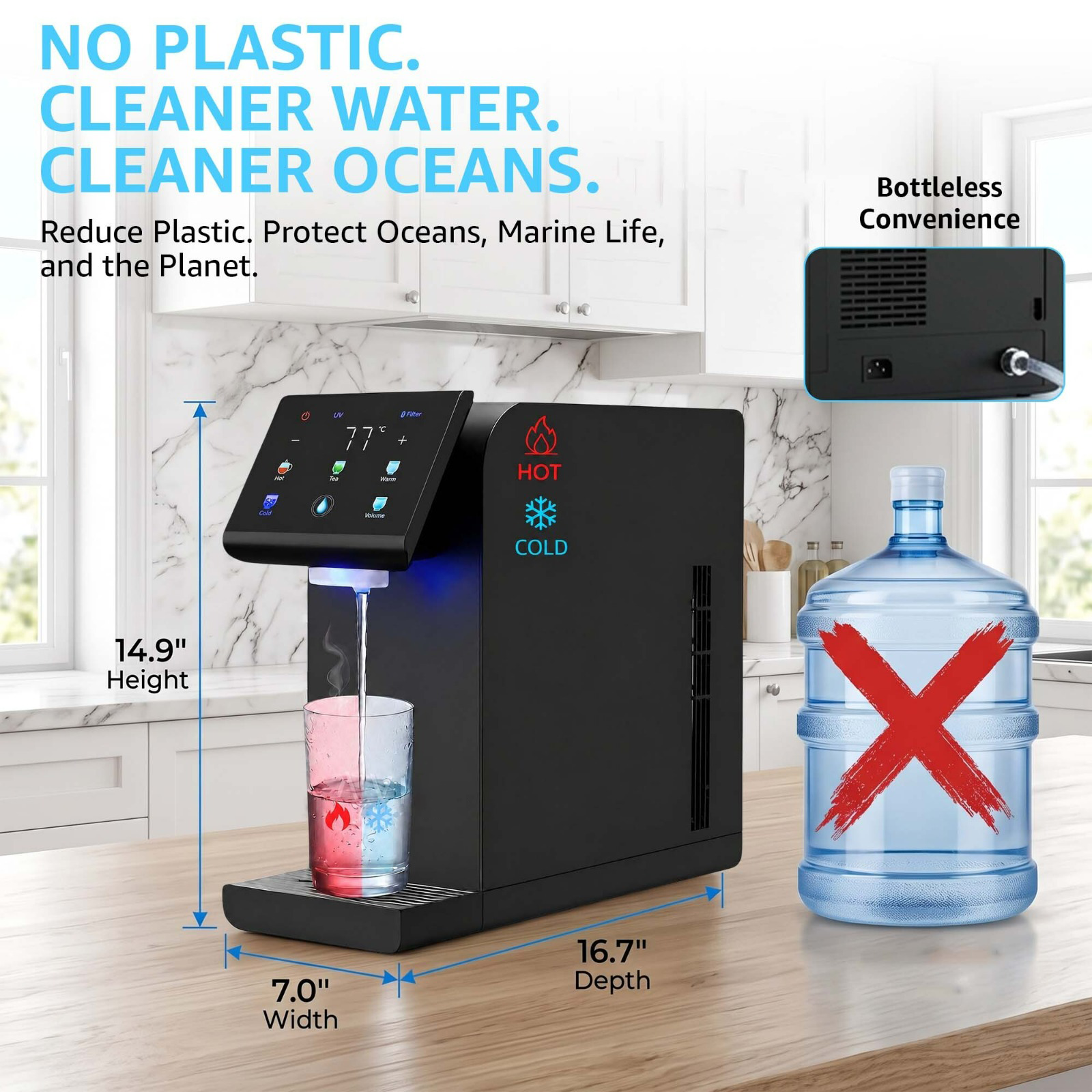
You bought a water purifier three years ago. It’s still running. The water tastes fine. The filter light still blinks green when you remember to reset it. So why does every advertisement, every salesperson, and every “industry trend” report tell you it’s time to upgrade?
Because the industry needs you to.
Here’s the uncomfortable truth the 2026 market data reveals: the era of first-time buyers is fading. In China, household penetration jumped from 20% in 2023 to roughly 30% in 2025. The easy growth is gone. What’s left is you—the existing owner—and the industry’s desperate need to convince you that what you have isn’t good enough.-1
This isn’t to say upgrades are never worthwhile. But the gap between what marketers promise and what you actually get has never been wider. Understanding why could save you hundreds of dollars and years of frustration.
The “Premium First-Time Buyer” Illusion
The 2026 white papers are full of triumphant statistics: 67% of premium countertop purifier buyers are first-time purchasers; 63% for under-sink models. The narrative writes itself: sophisticated new consumers are skipping the entry-level and going straight to high-end.-1
What the narrative omits is why. It’s not because entry-level purifiers are bad. It’s because the industry has spent a decade teaching consumers that cheap equals risky. Buy the $150 machine, the implicit message goes, and you’re gambling with your family’s health. Buy the $600 machine, and you’re a responsible parent.
The result is a market where “premium” has become the default entry point, not because the product demands it, but because the fear does.
What “Upgrade” Actually Means in 2026
Look closely at what the industry is selling as the next generation of water purification. The big three buzzwords: mineral preservation, ice-making capability, and AI-powered monitoring.
Mineral water purifiers grew from 7.0% to 20.7% of online sales in a single year. Ice-making products jumped from $43 million to $109 million. Every brand is racing to add a screen, an app, or a sensor that tells you your water is “optimized.”-1
Here’s what they don’t tell you: the core filtration technology hasn’t changed much. The RO membrane that removes lead and PFAS in a 2026 model is fundamentally the same membrane that did it in 2022. The carbon block that removes chlorine is still carbon. The sediment filter still catches dirt.
What’s changed is the packaging. The “mineral preservation” feature is often a small cartridge that adds calcium and magnesium back into water that the RO membrane just stripped them from. It’s a solution to a problem the industry created. The “AI monitoring” is frequently a timer with a Wi-Fi chip. The ice maker is a convenience, not a purification advancement.
None of these features are bad. But they’re not purification. They’re lifestyle. And lifestyle comes at a price—not just upfront, but in the form of more complex systems, more proprietary parts, and more things that can break.
The Hidden Cost of “More”
The 2026 industry consensus is clear: the market is shifting from “price war” to “value war”. Translation: brands can no longer compete on being cheapest, so they’re competing on being most feature-rich. The assumption is that consumers will pay more for more.-2
But more features mean more failure points. A purifier with a screen, an app, a mineral cartridge, an ice maker, and a heating element has exponentially more components that can malfunction than a simple three-stage RO system. And when they do malfunction—when the screen dies, when the app loses connection, when the mineral cartridge clogs—you’re not just dealing with bad water. You’re dealing with a repair bill for a device that’s become a small appliance ecosystem.
The traditional under-sink purifier, the one with no screen and no app and no ice maker, is increasingly positioned as “entry-level.” But for the vast majority of households, it’s the most reliable, lowest-maintenance, and most cost-effective option available. It does the one job that matters—removing contaminants—and it does it with fewer things that can go wrong.
The Real Upgrade: Knowing What You Actually Need
If you’re considering replacing your current purifier, the most valuable upgrade isn’t a new machine. It’s clarity.
First, test your water. Not the TDS meter on your faucet. A real lab test. The contaminants in your water determine what you need, not the features on the box. If your municipal water is safe and you just want better taste, a quality carbon filter is sufficient. You don’t need a $600 AI-powered mineral-enhancing ice-making machine.
Second, calculate your actual cost of ownership. That $600 machine with the proprietary mineral cartridge? The cartridge costs $80 and needs replacing every six months. That $150 machine with standard filters? $40 a year. Over five years, the “premium” option costs $600 more in consumables alone. The cheaper machine isn’t a compromise. It’s the rational choice.
Third, ask what problem you’re solving. If your current purifier delivers clean, good-tasting water and the filters are affordable and accessible, you don’t have a problem. The industry’s desire for you to upgrade is not your problem. It’s their problem.
The Bottom Line
The water purifier industry in 2026 is in transition. The easy growth is gone. The pressure to extract more revenue from existing customers is immense. And the marketing machinery is working overtime to convince you that what you have is obsolete.
Some of it is true. If your purifier is ten years old, if filters are hard to find, if the system is leaking or making strange noises—yes, replace it. But replace it with something simpler, not more complex. Replace it with something that solves your water problem and nothing else.
The best upgrade isn’t always a new machine. Sometimes it’s the decision to stop upgrading and start trusting what you already have.
Post time: Oct-27-2026